




What are the main functions and parameters of the power conversion system (PCS) for energy storage?
Energy storage converter, abbreviated as PCS in English, may sound a bit technical, but it is actually the "heart" and "brain" of the energy storage system. Simply put, it is like the overall commander of the energy storage system, responsible for power conversion, system control, and safety protection. Today, we will explain in a simple and understandable way the main functions and parameters of PCS for everyone.
I. What Does PCS Do? A Detailed Explanation of Its Five Functions
1. The "Translator" of Electrical Energy: Converting DC to AC and Vice Versa
Imagine that the battery stores direct current (DC), just like the electricity in your phone's battery; while the power grid transmits alternating current (AC), similar to the electricity in the sockets on your wall. The PCS acts as a sophisticated "translator" capable of:
- During charging: Converting the AC from the power grid into DC to charge the battery.
- During discharging: Transforming the DC from the battery into AC to supply the power grid or power devices.
2. Three working modes, flexible for different scenarios
Grid-connected mode: Works hand in hand with the grid. The more electricity the grid needs, the more electricity I provide.
Off-grid mode: When the grid goes down, I take over and provide power independently, like an emergency generator.
Hybrid mode: Can quickly switch between grid-connected and off-grid modes. The switching speed is as fast as 0.02 seconds, faster than a blink of an eye.
3. Intelligent power regulation, the "good helper" of the power grid
Active power regulation: According to the grid's demand, quickly adjust the power generation or consumption, with an extremely fast response time (≤ 0.1 seconds)
Reactive power compensation: Improves grid quality and enhances power usage efficiency, like providing "maintenance" for the grid
Voltage support: When the grid experiences voltage drops, it can continue to operate and provide support
4. Comprehensive safety protection, more peace of mind when using electricity
PCS has multiple protection mechanisms, like having a 24-hour security guard:
Voltage abnormality protection
Current overload protection
Short circuit protection
Overheating protection
All protection response times are less than 0.02 seconds, ensuring system safety
5. Intelligent management, everything under control
Supports multiple communication protocols and can have intelligent conversations with other devices
Real-time monitoring of over 50 operating parameters
Automatically records fault information and operation data, with the longest retention period of up to half a year
II. Interpretation of Key Parameters, Eliminating Confusion in Selection
1. Performance Indicators
Power Range: From as low as 50 kilowatts (approximately equivalent to 70 household air conditioners) to as high as 5 megawatts (capable of serving 5,000 households)
Conversion Efficiency: The overall charging and discharging efficiency is ≥ 98.5%, meaning that only 1.5 degrees of electricity are lost for every 100 degrees consumed during the conversion process
Voltage Range:
DC Side: 300 - 1500V, perfectly matching lithium batteries
AC Side: 400V/690V (low voltage), 10kV/35kV (high voltage)
2. Response Speed
Charge and discharge switching: ≤ 0.1 seconds to complete
Power Adjustment: At least 10% of the rated power can be adjusted per second
3. Environmental Adaptability
Operating Temperature: -25°C to 50°C, capable of operating in both extreme cold and heat
Protection Grade:
Indoor Type: Splash-proof and dust-proof
Outdoor Type: Completely dust-proof and resistant to water and erosion
4. Grid Adaptability
Can adapt to minor grid frequency fluctuations
Can withstand ±10% voltage fluctuations
III. How to Choose in Different Scenarios?
IV. Selection Guide for Referens
1. There are tricks to power selection
Remember this formula: PCS power = actual load power × 1.2
For example, for a 200kW load, it is recommended to choose a 250kW PCS, leaving sufficient margin
2. Efficiency is money
Choose products that use the latest SiC components. The efficiency can be improved by 2-3%, and the long-term power-saving effect is obvious
3. Compatibility is key
Ensure that the PCS can communicate smoothly with the battery management system (BMS) and energy management system (EMS), just like team members using the same language for communication
V.PCS and BMS
The cooperation between PCS and BMS is like the engine and driving computer of a car. They must work perfectly together:
1. Communication must be smooth
Select standard communication protocols to ensure that devices can "understand" each other's messages
The transmission delay of important signals should be less than 0.05 seconds
2. Electrical parameters must match
The voltage range should be consistent
The current size should be coordinated to avoid overcharging or overdischarging of the battery
3. Safety protection must be interlinked
Establish a three-level protection mechanism:
Primary: Cool down first when the temperature is high
Intermediate: Limit power when the abnormality is too large
Advanced: Emergency stop when in dangerous situation
4. Architecture selection must be reasonable
Centralized: Suitable for situations where battery consistency is good
String-connected: More appropriate when battery differences are large, which can increase the system capacity by 15-20%
Safety Guide
Choose modular design: Facilitates later maintenance and upgrade
Require collaboration with suppliers: Have the PCS and BMS suppliers jointly debug to avoid "arguing"
Request test reports: Require providing third-party compatibility test certificates
Product recommendation
Stability
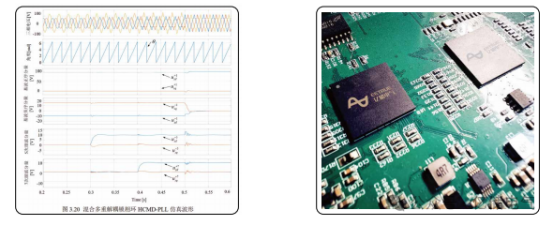
1. Adopting the third-generation DSP + FPGA dual-core architecture, the running frequency and instruction speed have been significantly enhanced;
2. Utilizing the hybrid multiple decoupling HCMD phase-locked loop (PLL) algorithm, it effectively extracts the voltage and frequency of the fundamental component of the power grid, enabling timely response to grid voltage disturbances, thereby improving grid connection stability and robustness;
3. Adopting a hierarchical design, with heat sources and control systems separated at different levels, it enhances the system's heat dissipation performance, lifespan, stability, and achieves IP65 level dustproof and waterproof capabilities.
Safety
1. Utilizing fiber optic drive technology, optical signals replace electrical signals. The control signals and drive signals are isolated by photoelectric high voltage. The control system becomes more stable and secure.
2. Efficient thermal management. Optional intelligent air cooling or liquid cooling. The intelligent air cooling adopts heat pipe and refrigerant cooling technology, while the liquid cooling is designed with our own flow channels, achieving efficient heat transfer and enhancing the heat dissipation efficiency of power devices. Full power output ensures revenue benefits.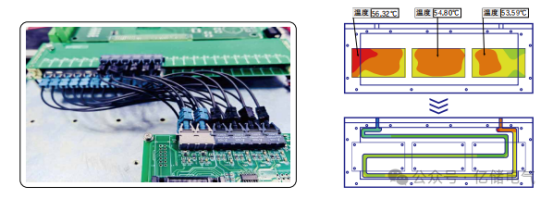
Scalable
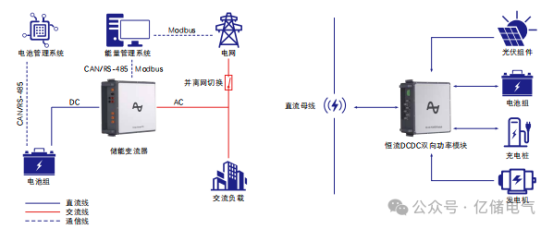
1. Scalable multi-level mode, configure appropriate DC/DC and PCS modules according to application scenarios to achieve reliable operation of a multi-source DC and AC shared DC bus energy storage system;
2. High, low voltage and power scalability, modular design of functional systems, rapid response to customized requirements of different voltage levels and power levels; support parallel operation mode; scalable multiple communication and control interfaces, support third-party external EMS devices.
Product features
Flexible configuration, multi-pole mode is scalable, can adopt a common DC bus structure, and supports a 1000V high-voltage DC bus.
DC/DC bidirectional energy flow, the DC input side can adopt a constant current mode, with a maximum current of 300A.
Efficient thermal management, using heat pipes and layered design.
Wide input/output DC voltage range, compatible with 200Vdc - 1000Vdc systems.
Satisfies the functions of integrating new energy storage batteries, photovoltaic modules, new energy vehicles, such as configuring new energy vehicle V2G, MPPT, mobile energy storage intelligent charging robot DC fast charging, etc.
Modular design, maintenance is more convenient.