




The development potential of grid-connected energy storage in the future!
The grid-forming energy storage system is a new type of energy storage system with the ability to actively regulate the voltage and frequency characteristics of the power grid. Unlike the traditional "following the grid instructions" source-grid type energy storage, it can provide services such as voltage support, inertia response, frequency and voltage regulation for the power grid like a synchronous generator, and is the core technical solution for addressing the insufficient stability of the power grid after the integration of a high proportion of new energy sources.
I. Core Feature: Actively support the power grid, rather than respond passively.
II. Core Technology Support
III. The Core Difference from Grid-connected Energy Storage
IV. Typical Application Scenarios
I. Core Feature: Actively support the power grid, rather than respond passively.
The core function of traditional grid-connected energy storage is "energy throughput" (such as peak-valley arbitrage, peak shaving and valley filling), which relies on the grid to provide stable voltage and frequency references and does not have the ability to independently form a network; Grid-forming energy storage achieves three core capabilities through advanced converter control technologies (such as virtual synchronous machine technology, droop control technology), by simulating the rotor characteristics and electromagnetic properties of synchronous generators:
1.Voltage/frequency active support
Without the need for grid reference signals, it can autonomously establish and maintain the voltage amplitude and frequency stability of the grid. It does not disconnect from the grid even in grid faults or weak grid scenarios.
2.Inertia and damping provision
Through virtual inertia control, it provides rotational inertia support for the grid, alleviating the "low inertia" problem of the grid caused by new energy generation (photovoltaic and wind power have no rotational inertia), and enhancing the grid's disturbance resistance capability.
3.Black start capability
It can autonomously start up and drive the generator sets and load to resume operation in the event of a complete blackout of the power grid, becoming an important backup power source for emergency situations of the power grid.
II. Core Technology Support
The core of the grid-connected energy storage lies in the coordinated optimization of the control system and the inverter. The key technologies include:
1.Virtual Synchronization Generator (VSG) technology
This is the core control technology of grid-connected energy storage. It uses software algorithms to simulate the rotor motion equation of synchronous generators, enabling the energy storage converter to possess the external characteristics of synchronous generators and achieving flexible regulation of inertia and damping.
2.High-performance Energy Storage Converter (PCS)
It adopts wide bandgap semiconductor materials such as silicon carbide (SiC) to enhance the response speed, efficiency and overload capacity of the converter, meeting the requirements of grid-connected control for rapid power regulation.
3.Cluster collaborative control technology
For large-scale grid-connected energy storage power stations, it realizes the synchronous coordinated operation of multiple energy storage units, avoiding oscillation problems when multiple units are connected in parallel, and ensuring the stable output of the entire power station.
III. The Core Difference from Grid-connected Energy Storag
IV. Typical Application Scenarios
1.Support for New Energy Large-scale Bases
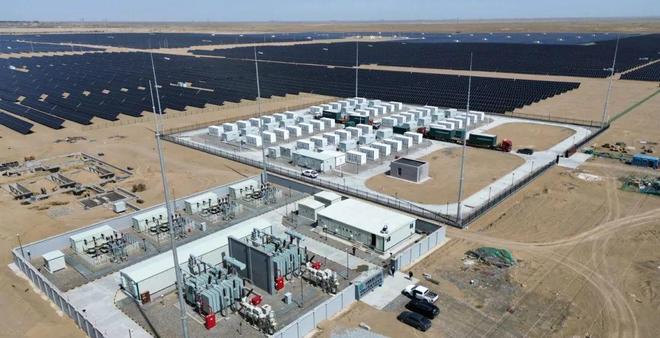
In large-scale wind and solar power bases such as "Shagaoqiao", grid-connected energy storage can stabilize the fluctuations in the output of new energy sources, provide inertia support, and solve the grid stability problems in long-distance power transmission.
2.Weak Grid / Power Supply in Remote Areas
In the end of the grid or in remote areas such as islands and highlands with weak grids, grid-connected energy storage can independently build a stable grid and ensure reliable power supply for local loads.
3.Emergency Guarantee for Urban Power Grids
As embedded energy storage in urban substations, it provides black start services during grid failures, quickly restoring power supply to critical loads (such as data centers and hospitals).
4.Core of Microgrid System
In the microgrid system of "photovoltaic + energy storage + load", grid-connected energy storage serves as the core power source, enabling the microgrid to operate independently in an isolated mode and reducing dependence on the main grid.