




AC-Coupled Multi-Modal Photovoltaic Energy Storage System: One Article to Help You Understand AC-Coupled Control and Self-Healing Mechanism during Power Outages!
AC Coupled Multimode System (AC Coupled Multi-mode System): On the photovoltaic side, the grid-connected inverter first converts DC to AC and feeds it into the AC bus. On the energy storage side, a multimode inverter (also commonly referred to as "energy storage inverter/bidirectional inverter/combined inverter and charger") that can both grid connect and operate off-grid is used to complete battery charging and discharging as well as backup power supply. The system separates critical loads from the main distribution through a backup load distribution box, forming a "home microgrid (Microgrid)" that operates independently during power outages.
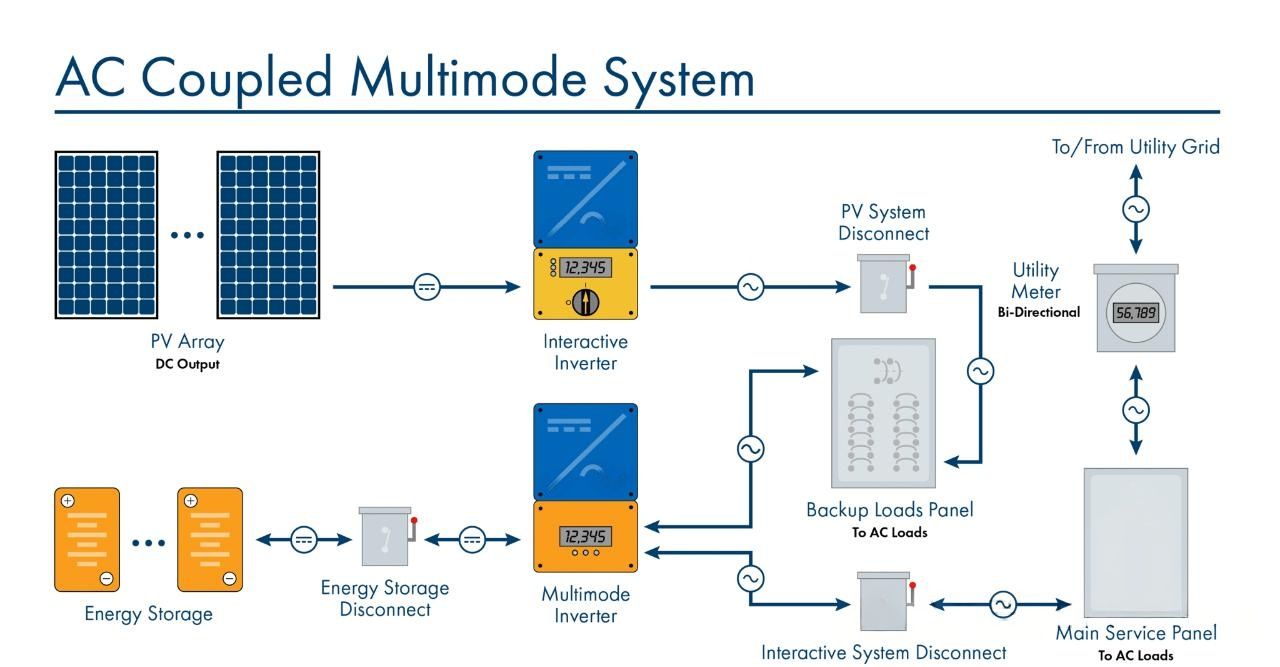
1.The key equipment in the diagram is disassembled one by one (corresponding to the electrical boundary):
PV Array (Solar Array, DC Output)
◆The output of the photovoltaic module is DC (Direct Current), and the voltage/current varies with irradiance and temperature.
◆The advantages of direct current are that it is easy to connect components in series or parallel and has high efficiency; however, household loads and power grids are usually AC systems, so it must be inverted.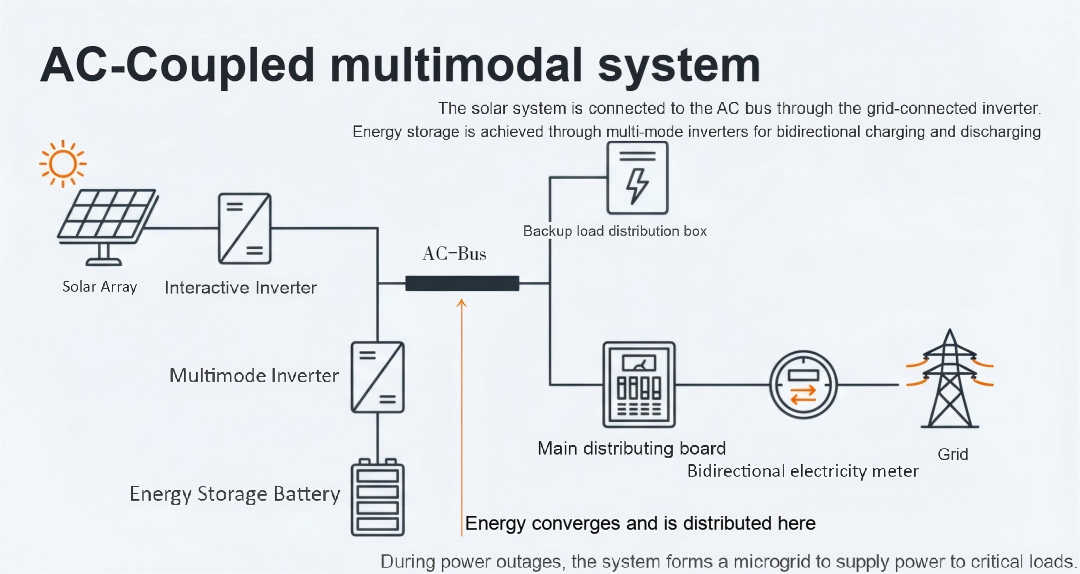
Interactive Inverter (Grid-Tied / Grid-Following Inverter)
◆"The Interactive" aspect indicates its interaction with the grid: converting PV direct current into AC (Alternating Current, alternating electricity) for grid connection.
◆The typical grid-connected inverter belongs to GFL (Grid-Following): it requires an external "grid voltage/frequency reference" to achieve stable output; once the grid loses power, it will trigger Anti-Islanding (protection against islanding) shutdown to prevent reverse power flow from endangering the repair personnel.
Multimode Inverter (Multi-mode Inverter, Grid-Tied + Off-Grid / Grid-Forming)
◆"Multi-mode" means it can operate in multiple modes: it can synchronize with the grid when connected to the grid; and it can actively "form the grid" when the power is off.
◆The core capability is "two-way transformation":
☆Rectification: AC → DC - Charging the battery
☆Inversion: DC (battery) → AC to supply power to the load
◆In the power outage mode, the multi-mode inverter typically operates as a GFM (Grid-Forming): It outputs stable voltage and frequency, simulating the "grid", allowing for the formation of a controllable AC bus within the system.
Backup Loads Panel (Backup Load Distribution Panel, Critical Loads Panel)
◆Separate the critical loads (refrigerator, lighting, router, some sockets, etc.) from the Main Service Panel.
◆Objective: During power outages, only critical loads should be powered on to prevent large-power loads such as air conditioners and electric stoves from overwhelming the energy storage system.Utility Meter Bi-Directional (Bidirectional Electric Meter)
◆It records the electricity consumed for purchase (Import) and the electricity sent out for use (Export), which forms the basis for settlement and revenue accounting.
◆Under the self-generation and self-consumption / surplus power fed back to the grid model, the two-way metering determines how much you have "saved" and how much you have "sold".
PV System Disconnect / Energy Storage Disconnect / Interactive System Disconnect (Various disconnect switches / disconnect devices)
◆PV System Disconnect / Energy Storage Disconnect / Interactive System Disconnect (Various disconnect switches / disconnect devices)
"Disconnection" (Isolation/Deactivation) is the "safety baseline" for project implementation: Maintenance, fault isolation, fire alarm linkage, and grid connection regulations all require clearly defined visible breakpoints.
◆Among them, the Interactive System Disconnect usually plays the role of "physical isolation from the power grid", ensuring that no reverse power flow occurs to the public grid during a power outage (a hard isolation layer for preventing islanding).
2. The essence of AC coupling: Energy "converges" on the AC bus. The battery participates through a secondary conversion.
The reference content you provided captures the key points: PV first converts to AC and then charges the battery. The battery discharges and then converts to AC to supply the load. When the energy flow path is expanded, the most common ones are four:
Path A: PV → Household Load (Self-generation for self-use)
PV DC → Grid-tie Inverter (DC→AC) → Backup Load/Main Load
◎This path determines the main benefit of "energy savings on the household side".
Path B: PV → Battery charging (secondary transformation with AC coupling)
PV DC → Grid-connected inverter (DC → AC) → Multi-mode inverter (AC → DC) → Battery
◎Here, there is an additional transformation, so the system efficiency depends on the multiplication of the efficiencies of the two inverters (grid-connected inverter × energy storage inverter rectification efficiency).
Path C: Battery discharging → Supply to load
Battery DC → Multi-mode inverter (DC→AC) → Backup load / Main load
Path D: Grid ↔ Home (including battery charging / peak shaving)
Grid AC ↔ Main Distribution Panel ↔ Multi-mode Inverter
◎Under time-of-use pricing (TOU), multi-mode inverters can choose to charge at a lower price and discharge at a higher price, thereby achieving peak shaving and load shifting.
3. Why can there still be "continuous power supply even during power outages"?
The key lies in "network formation + keeping the grid-connected inverters connected".
Your description of "During power outages, the multi-mode inverter simulates the grid signal to keep the interactive inverter online" is very professional. Here, the mechanism is explained thoroughly:
3.1 Role Division of the Two Types of Inverters
The grid-connected inverter (GFL) will simply "follow the grid". Without the grid, it will shut down (to prevent islanding).
After the battery backup mode is switched, the multi-mode inverter becomes "grid-connected mode" (GFM) and supplies power to the system:
○Voltage reference
○Frequency reference
○Short-term power balance
So, the grid-connected inverter "assumed that the grid was still operational" and continued to supply the PV power to this "household micro-grid bus".
3.2 Three typical states of backup power operation (great for your article)
1. Adequate PV power, moderate load, and battery rechargeable
2. PV power supplies the load and the excess power is rectified by the multi-mode inverter and then charged to the battery.
When the PV output is sufficient, the load is very small, and the battery is nearly fully charged (limiting the power output is necessary)
If the power output is not limited, the PV power has nowhere to go, and the bus voltage/frequency will be pushed up, triggering protection and tripping.
In engineering, there are two types of "power output limitation" methods:
○Frequency Upshift Limit Power (Frequency-Watt / Frequency Shift Power Control): The multi-mode inverter slightly increases the frequency, prompting the grid-connected inverter to reduce power in accordance with the grid connection procedures.
○Communication-based Curtailment: Directly issue power-limiting instructions to grid-connected inverters through communication protocols (more precise, but requires ecosystem compatibility).
4.What's AC coupling vs DC coupling: A brief selection suggestion?
○AC coupling is more suitable for scenarios such as existing grid-connected photovoltaic installations that need to be upgraded, those that wish to quickly install energy storage or backup power systems, and systems with clear division of responsibilities (one set for PV and another for energy storage).
○DC coupling is more suitable for: new integrated systems, the pursuit of higher "PV → battery" efficiency, and the desire to reduce the number of devices and transformation steps.